
Hiring Through Hackathons: A Recruiter's Guide to MLH Talent

The engineers worth hiring are the ones who build. This guide covers why hackathon talent is different, what MLH’s community looks like, and the two ways companies actually hire through it.
The Roles You Most Need are the Ones You Can’t Fill
Engineering is the hardest, slowest, and most expensive hire in the building.
Engineering is the toughest hire most companies make. In Universum’s 2025 research, 73% of talent-acquisition leaders named engineers their single hardest profile to fill, and Robert Half’s 2026 data says the squeeze is tightening: Roughly 65% of technology hiring managers report that finding skilled professionals got harder over the past year.
The math behind the difficulty is unforgiving. Around 70% of the engineering talent pool is passive. They’re already employed, not applying anywhere, or invisible to a recruitment activation. Time-to-fill for engineering roles routinely runs past the general 42-day benchmark tracked by SHRM, with some datasets putting it between 45 and 62 days depending on seniority. Every one of those days is a delayed migration, a missed release goal, a design review that drags because the senior engineers are covering the gap.
Getting it wrong is expensive to your budget. Cost-per-hire for technical roles commonly lands between $6,000 and $10,000 before anyone writes an agency check, and a bad hire runs at least 30% of that employee’s first-year earnings by the US Department of Labor’s estimate. For an early-career engineering hire, the expensive mistake isn’t paying too much. It’s spending three months and a dedicated employee’s time to learn that someone who interviewed well can’t actually build.

The Résumé is the Wrong Filter
The whole industry is moving from credentials to demonstrated skill.
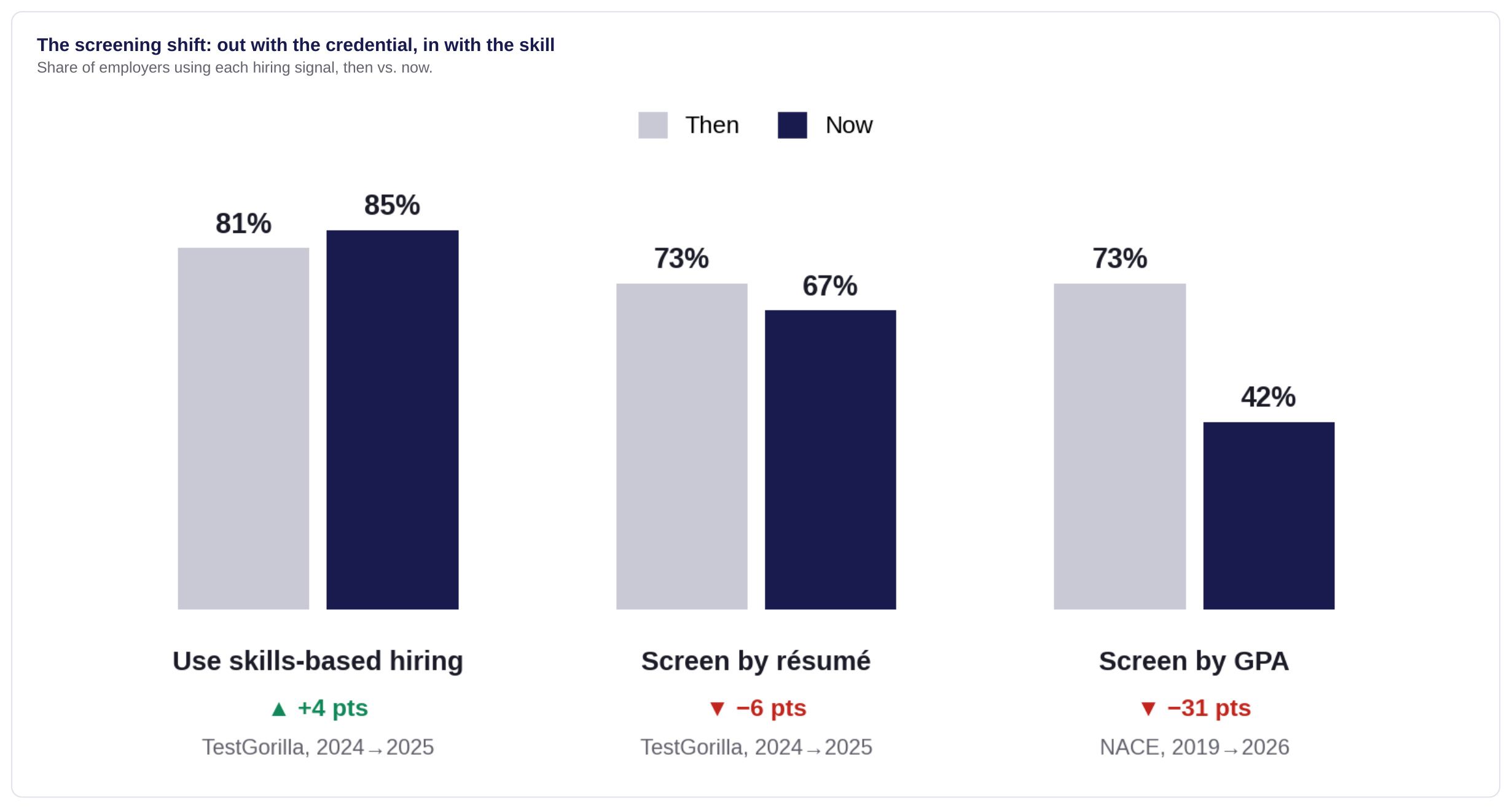
The market is quietly admitting this. Skills-based hiring is now the default: 85% of employers used it in 2025, up from 81% the year before, while résumé screening slipped from 73% to 67%. The credential that used to gate the funnel is falling fastest of all: GPA screening dropped from roughly 73% of employers in 2019 to 42% by 2026.
The reason is simple. A résumé is a claim, but it isn’t evidence. And the claims are getting noisier: 73% of employers say they’re seeing more AI-generated résumés than before, which muffles what little power the document carried. It shows in how they’re read. 71% of employers now spend under 15 minutes on a résumé, and about a quarter spend under five. Nobody reads closely, because there isn’t much worth reading closely anymore.
What actually predicts whether someone can do the job is watching them do something like it. Work samples and practical, job-shaped assessments have been the strongest predictors of performance in hiring research for decades. And the prospects agree: According to HackerRank’s 2025 Developer Skills Report, 66% of developers say they prefer practical challenges that mirror real day-to-day work over abstract puzzles.
A Major League Hacking (MLH) hackathon project is a work sample that already happened. It shows initiative, because nobody assigned it. It shows collaboration under a clock. And it shows the one thing every hiring manager wants to know and no résumé can carry: this person can take an idea and ship something real. As MLH’s Jon Gottfried frames the shift, AI now generates the bricks, but someone still has to build the house. The taste and judgment that matter live in what a person builds, not in what they list.
What is Major League Hacking (MLH) Talent?
The largest early-career developer community in the world, pre-sorted by what people chose to build.
Major League Hacking runs the largest community of early-career developers anywhere: They reach 1.5 million hackers through events and programs, and with the 2026 addition of DEV, they reach a combined network approaching five million software creators globally.
Two things make that pool worth a recruiter’s attention. The first is diversity that campus pipelines struggle to match: MLH describes its community as more than twice as diverse as the average US computer-science classroom, and nearly twice as gender diverse as a typical undergrad CS classroom. The second is that the experience is real rather than simulated. MLH powers 200+ in-person hackathons in a season, reaching hundreds of thousands of students, and reports that 51% of its alumni have taken a technology they first learned through MLH into production at their job. These are people who build with current tools and carry them into real codebases.
The skills map to what teams hire for including Python, JavaScript, Java, C/C++, C# and more, and the profiles arrive pre-sorted by what each person actually chose to build.
Two Ways to Access MLH’s Network of Talent
One front door for awareness and one for evaluation.
MLH gives companies three distinct entry points, depending on whether the goal is reach, evaluation, or a straight-to-hire.
-
Season Sponsorship. The widest top of the funnel.
Companies put their tools directly into the hands of thousands of builders across the hackathon season, earn brand affinity with the next generation of engineers, and get real product feedback in the process. -
Fellowship Partnership. The evaluation channel.
Partners sponsor a cohort of Fellows through a 12-week program and watch them contribute to real projects over three months. MLH frames it as a drop-in, scalable talent pipeline; the recruiting advantage is deciding who to hire from a place of knowledge, after seeing the work rather than after reading about it.

Across the 2023 season, MLH promoted Twilio at 170 events. By season’s end, more than 2,000 developers had built with Twilio products, 585 of those projects were submitted, and Twilio had reached more than 200,000 developers worldwide. That is what the season channel produces when a company treats it as more than a logo placement.
Why It Works
Mutual filtering, and the work in view before the offer.
The mechanism underneath all three channels is the same, and it’s the reason hackathon hiring outperforms a job post. Developers self-select into events built around the tools they want to use professionally. A company at one of those events isn’t broadcasting to a random crowd. It’s meeting people who already chose its stack. The filtering is mutual, and it happens before anyone talks to a recruiter.
At every step, the company sees the work before it makes the offer. That’s the whole thesis. In a market where the best engineers aren’t applying, where résumés get five minutes of attention, and where a wrong hire costs a quarter of a salary, the channel that lets a company watch someone build isn’t a nice-to-have. It’s the one that works.
To talk through which channel fits a given hiring goal, teams can connect with MLH’s partnerships team.
How To Read a Hackathon Project like a Recruiter
The five signals to look for:
It's deployed.
A live demo beats a repo full of good intentions. Shipping something that runs is the skill under evaluation, and it's the one most résumés can't prove.
The README is real.
Clear setup steps, what the thing does, and what's next signal someone who cares how their work is received — the same instinct that makes a good teammate.
The commit history tells a story.
Iterative commits over time show how a person actually works. One giant final dump usually hides a scramble.
Their role is legible.
On a team build, look for what this specific person owned. Hackathon projects are collaborative by design, and knowing who did what is the point.
They chose the problem.
What someone builds when nobody assigned it is the truest read on drive and taste — exactly the judgment that matters most once AI handles the boilerplate.